Research Focus
I work at the intersection of artificial intelligence and Earth system science at KIT. I also serve as Scientific Coordinator for the ECMWF Machine Learning Training Program under the DestinE initiative, contributing to international efforts in AI-driven Earth system modeling.
My research focuses on developing physically consistent and interpretable AI models to better understand atmospheric processes across scales. In particular, I work on representation learning and generative modeling using satellite/ground-based observations and km-scale numerical simulations.
More broadly, my goal is to bridge the gap between predictive skill and scientific understanding, enabling trustworthy AI for weather forecasting and climate-scale applications.
News & Updates
- New Preprint — Satellite-trained latent spaces for evaluating km-scale atmospheric simulations is now available on ESS Open Archive. We use satellite-trained representations to evaluate how ICON-EU and IFS reproduce cloud regimes and their transitions. Read the preprint
- ECMWF–ESA Workshop — Presented work on evaluating km-scale numerical models against satellite observations.
Slides · Recorded Talk - MLESM Hackathon 2026 — Contributing a challenge on AI emulators of chaotic atmospheric dynamics, exploring predictability, physical consistency, and long-term stability using the Lorenz system.
Hackathon webpage · Challenge description - April 2026 🇸🇪 — Appointed to a permanent Machine Learning Scientist position at the Swedish Meteorological and Hydrological Institute (SMHI), starting October 2026.
- September 2025 — Scientific Coordinator for the ECMWF Machine Learning Training Program under the DestinE initiative.
Featured Research
Ongoing Work
Evaluating convection in km-scale numerical models against satellite observations through a shared latent representation.
Latent-space evolution of cloud systems from satellite observations and numerical simulations (ICON, IFS).
Recent Publication
Learning representations of geostationary satellite imagery to identify low-level cloud systems and quantify their impact on solar energy variability.
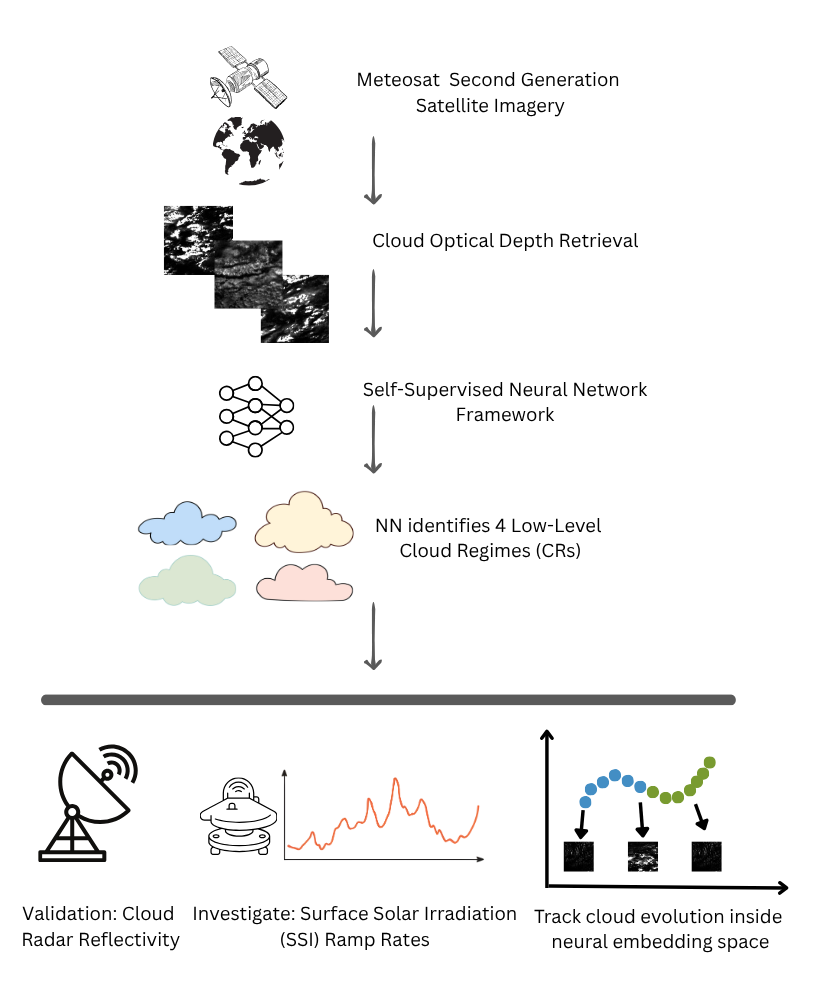
Framework linking cloud organization to solar energy ramp events.
Current Work
- Evaluating km-scale numerical models in latent representation space
- Developing conditional diffusion models for satellite–radar mapping
- Studying cloud regime transitions and multiscale dynamics
Research Themes
Representation Learning for Cloud systems
Learning compact representations of satellite observations to study cloud regimes, transitions, maturity, and diurnal variability.
AI for Physical Understanding
Using deep learning not only for prediction, but also as a tool to uncover structure in complex atmospheric systems.
Generative Models for Earth Systems
Developing probabilistic and generative models to connect satellite observations, radar measurements, and physical processes.